
First-released Date | Apr. 26, 2022 | Updated Date | May 23, 2022 | Sep. 18, 2022 | Feb. 23, 2023 |
Abstract:
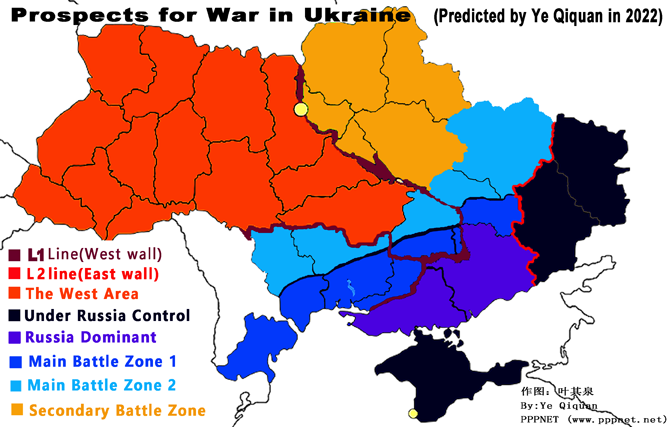
In the Russia-Ukraine conflict, the United States holds the greatest influence over determining ceasefire lines, though Russia, Western Europe, and China also constitute significant background factors. Theoretically, three ceasefire lines exist. The first is a geographical demarcation line defined by the Dnieper River and the Black Sea coastline. This could also be defined as the western boundary of the battlefield. The second is delineated by the complete administrative borders of the Luhansk and Donetsk regions. This line also serves as the eastern boundary of the conflict. The third category of ceasefire lines consists of arbitrary arcs drawn within the broad expanse between the western boundary wall (Line L1) and the eastern boundary wall (Line L2). Should the United States pursue only limited outcomes in this Russo-Ukrainian conflict, seeking to avoid direct entanglement with additional nations, it would retain sufficient initiative to establish a stable ceasefire line at some point along L1, L2, or even L3. For Russia, ceasefire lines along L1 and L2 would offer more certain prospects compared to the uncertainty inherent in L3. Ukraine remains unwilling to accept L1. However, Ukraine holds no say in whether the war continues or ceases. The enduring viability of the L1 line stems from its non-compromising of American strategic interests. The foremost reason for the L2 line’s perpetual possibility is America’s overwhelming superiority on Ukrainian soil. The second reason is that a ceasefire at the L2 line would not inflict a major political defeat upon Russia. The third reason is China’s likely endorsement of this line.
Keywords: Russia-Ukraine War, ceasefire line, battlefield boundary wall, Ukraine’s Somalisation, Ukraine’s Yugoslavisation.
Original concepts introduced in this article
L1 Ceasefire Line
This ceasefire line follows the Dnieper River and Black Sea coastline. It would definitively delineate the entirety of Western Ukraine. Ukraine’s rejection of this line is understandable. This ceasefire line would result in Ukraine losing too much territory. Only an extremely weakened Ukraine would accept this reality. It would also mark a political and military failure for the West.
However, the possibility of this ceasefire line remains theoretically viable indefinitely. The primary reason is that this line would not harm US strategic interests. Moreover, the US could more effectively control the costs of the war along this line.
L2 Ceasefire Line
This constitutes a ceasefire line formed along the complete administrative borders of Donetsk and Luhansk. It would also represent the absolute bottom line Russia must defend. The American camp cannot and will not cross this line (at least until 2026).
Advancing the frontline to this point represents an extraordinarily difficult choice for both the United States and Ukraine. Should Ukraine and its leadership persist in treating this line as their ultimate objective, Ukraine would face immense risks.
1. Ukraine could only potentially advance the frontline to the L2 line after enduring a series of brutal battles. The inevitable consequence would be the complete destruction of the nation’s economic foundations and the livelihoods of its people.
2. Ukraine could only achieve this ambition with sustained military support from other nations. Should Ukraine’s allies establish multiple parallel administrations outside the central government, Ukraine would lose control over its own territory. When these local entities demand returns on their prior investments, Ukraine risks becoming a Somalianised state. The worst-case scenario would replicate the disintegration of Yugoslavia.
3. Should protracted fighting erupt in Central Ukraine, Russia would endeavour to establish approximately seven autonomous local governments in Central and Southern Ukraine to mitigate sustained American pressure. This would inevitably precipitate Ukraine’s Yugoslavisation.
4. Accepting a ceasefire along the L2 line signifies Russia’s inability to overcome dual military and economic failures. However, a ceasefire along this line would not constitute Russia’s complete political defeat, thus precluding discussions of nuclear options.
5. This line undoubtedly represents Russia’s bottom line and the eastern boundary wall of the Russia-Ukraine war. Any military attempts beyond this wall would inevitably trigger discussions of nuclear options.
6. The L2 line also presents China with a viable land-based option to block NATO expansion. It offers sound operational feasibility politically, militarily, economically, and geopolitically.
L3 Ceasefire Line
This refers to a set of ceasefire lines situated between the L1 and L2 lines. Ceasefires in this zone are relatively unstable, as neither side has been decisively defeated. The next conflict could erupt easily. Yet establishing a ceasefire here represents a straightforward political manoeuvre. Powerful political figures can readily cash in their political capital at this “political investment bank”. When political capital is required, they can declare ceasefires or reignite hostilities across this vast territory at will.
The Somalisation of Ukraine
To sustain a protracted or even medium-term conflict, Ukraine must rely on the armed forces of its neighbours. Once these nations deploy troops into Ukraine to pursue their own national interests, Ukraine’s allies could precipitate its Somalisation.
The Yugoslavisation of Ukraine
To alleviate sustained pressure from the United States, Russia stands to gain from establishing several pro-Russian local administrations, including approximately seven autonomous regional governments. This would result in the Yugoslavisation of Ukraine. Ukraine’s allies could also contribute to this process.
European Divisions
A prompt ceasefire would benefit Europe by averting prolonged chaos. However, certain nations, particularly Ukraine’s neighbouring states, seek to prolong the conflict for their own national interests.
China Supports the L2 Line
Preventing NATO’s eastward expansion is not merely a pressing concern for Russia but also a medium-to-long-term challenge for China. Consequently, determining where and in which regions to establish China’s line of deterrence constitutes a highly sensitive and complex political and military issue. Supporting Russia along the L2 line aligns with China’s medium-term interests, offering substantial political, military, and economic manoeuvring space.
America Determines the War’s Course
This European conflict is widely termed the Russia-Ukraine War. In reality, the true players are America and Russia. They alone hold the decisive power to determine the ceasefire line’s location and timing. America possesses absolute military superiority in both Central and Western Ukraine.
Ukraine is the most incompetent party in this conflict.
Ukraine possesses no genuine authority over decisions regarding combat operations or ceasefires. Its capabilities are even weaker than those of several neighbouring states.
===Main Content====
Definition of Three Ceasefire Lines
In the Russia-Ukraine conflict, three theoretical ceasefire lines exist.
The L1 Line constitutes a geographical demarcation defined by the Dnieper River combined with the Black Sea coastline. This is a relatively stable yet difficult-to-achieve ceasefire line, serving as the ultimate line of resistance or barrier wall for the combat zone.
Line L2 is defined by the complete administrative borders of the Luhansk and Donetsk regions. It is a relatively stable but also the most challenging ceasefire line to attain. Its establishment signifies a significant military and economic setback for Russia. Simultaneously, this line constitutes the eastern boundary wall or line of resistance for the Russia-Ukraine conflict.
L3 Line: Any ceasefire line demarcated within the broad expanse between L1 and L2. It may solidify for limited periods or fluctuate constantly with the ebb and flow of combat and truces. It will not be stable, yet it is readily attainable.
L1 Line: Characteristics, Status and Prospects
1. Characteristics of the L1 Line
The L1 Line constitutes a geographical trench demarcated by the Dnieper River, potentially supplemented by the Black Sea coastline. Should both parties agree to adopt this line for a ceasefire, it would maintain relative stability over an extended period. The reasons are as follows:
1.1 Military Functional Line. This line possesses significant military attributes, effectively preventing or delaying any cross-river operations. This means the ceasefire line there has the practical function of reducing the frequency and intensity of clashes.
1.2 Cultural Divide. Significant differences exist in the cultural, psychological, and ethnic structures on either side of the river. This represents a culturally and psychologically acceptable border for both Russia and Ukraine. Although the Kyiv region, as a special case, lacks this characteristic. Both sides could agree to segregate populations with differing ethnic inclinations to opposite banks of the river. It may also carry historical memories of Eastern and Western Ukraine. If utilised effectively, Russia could leverage this line to gradually restore historical memories of Eastern and Western Ukraine.
1.3 Geographical Boundary. This presents an excellent geopolitical demarcation line, capable of halting the westward advance of Russian forces. Consequently, it diminishes the historical memory of ‘Europe’s’ apprehension towards Russia.
1.4 Political Line of Denial. This constitutes a fundamental line of resistance for the American bloc against Russia. This line along both banks of the Dnieper River (potentially including coastal territories on the Black Sea) may represent Russia’s greatest gain in this conflict. Without the consent of the American bloc, Russia could not have crossed this baseline alone. It is evident that the American bloc dislikes Russia crossing the western bank of the Dnieper to occupy parts of Western Ukraine.
2. Timeline for the Emergence of the L1 Line
The L1 ceasefire emerged when the US bloc and Russia demonstrated strong political will. The following factors prompted them to sit down and discuss the L1 line as a ceasefire demarcation.
2.1. Following Russia’s successful establishment of its own frontline on the eastern bank of the Dnieper River.
Russia successfully established its own frontline on the eastern bank of the Dnieper River,
and maintained this position despite multiple counterattacks by the Western bloc.
The United States may have hesitated, considering the immense costs and harsher consequences.
2.2. When certain neighbouring states expressed a strong desire to intervene in the conflict.
Should certain neighbouring states—such as Poland, Romania, Hungary, Turkey, and Lithuania—demonstrate a strong inclination to deploy troops into Ukraine, this would constitute an urgent moment for establishing a ceasefire line to prevent the war’s prolongation and escalation. Once these regional nations become embroiled in the conflict, the costs of managing the war for the United States would inevitably surge rapidly. A significant risk lies in the potential loss of an effective buffer zone between the American and Russian blocs. The primary motivation driving these neighbouring states to commit troops would not be for Ukraine’s benefit, but rather the allure of Western and Central Ukraine. Should these regional neighbours ultimately secure firm control over certain Ukrainian territories, Western and Central Ukraine would ultimately lose their function as a major buffer zone separating Russia from ‘Europe’.
2.3. When Political Pressure Emerges on the Chinese Front
Should substantial political pressure materialise from the Chinese front, the United States must immediately redirect its primary focus towards China. Even if traditional Chinese conduct precludes initiating conflict, the latter half of 2026 represents a genuine high-risk period. The West should commence close monitoring of Chinese public media from late 2025 onwards.
3. Prospects and Political Foundations of the L1 Line
Rationally speaking, among the three ceasefire proposals, the L1 line is not the most challenging, as both the United States and Russia find it relatively acceptable.
3.1 For Russia, naturally, the L1 line should represent the best achievable outcome in the immediate term. Russia would fully realise its primary objectives under this ceasefire line, including the demilitarisation of Ukrainian forces, the removal of anti-Russian elements, and the establishment of a strategic buffer zone to safeguard its national interests. Russia would be willing to maintain the stability of this ceasefire line. Given these substantial gains, Russia would likely tolerate low-level provocations from its hostile neighbours.
3.2 Should the United States regard China as its primary adversary, establishing a ceasefire line at L1 would be both rational and pragmatic for Washington. To date, the US has already secured its principal political objectives from this conflict, including weakening Europe, undermining Russia, and separating Russia from Europe via a robust Ukrainian trench system. Having secured these predetermined strategic gains, the US could halt its advance immediately, thereby avoiding the immense economic costs of further engagement. Naturally, a swift withdrawal at the L1 line would entail political costs associated with abandoning allies.
3.3 Ukraine’s Reluctance to Accept an L1 Ceasefire Ukraine remains unwilling to accept a ceasefire at the L1 line until its military and economic strength is exhausted. No Ukrainian politician dares acknowledge the reality of halting hostilities at this line. Any ceasefire before Ukraine completely loses its capacity to counter Russia would be tantamount to suicide – not merely at the L1 line, but anywhere.
A ceasefire along the L1 line, while daunting, would not represent Ukraine’s worst-case scenario. Ukraine cannot expel Russia from its territory through its own strength alone. Should Ukraine rely on neighbouring states’ armed forces to counter Russia, it would inevitably face the dire outcomes of Somalisation or Yugoslavisation during or after the conflict.
Historically, a certain bad outcome is far preferable to an uncertain one. Yet politically, a certain bad outcome is far worse than an uncertain, potentially worse one.
However, Ukraine holds no substantive say over whether the war continues or ceases. Its political capacity is even weaker than that of its neighbouring allies.
3.4 Europe’s assessment of the Russia-Ukraine conflict is divided. Establishing a ceasefire agreement anywhere as swiftly as possible aligns with the interests of Europe as a whole, particularly its core powers. A prompt truce would help Europe avoid prolonged chaos. Nevertheless, certain nations, especially regional states bordering Ukraine, seek to prolong the conflict for their own national interests. Indeed, a divided and weakened Europe also serves America’s long-term strategic objectives. It could enhance American influence across Europe and reduce the cost of managing the world. This constitutes a major reason for American willingness to prolong the conflict.
3.5 Regardless, establishing a ceasefire line along the L1 line would not harm American strategic interests. This represents the strongest rationale for the L1 line’s enduring viability as a ceasefire demarcation. Moreover, owing to the four characteristics of the L1 line outlined above, the cost to America of managing the conflict along this line is lower than in other regions.
L2 Line: Realistic Characteristics, Opportunities, and Prospects
The L2 line is delineated along the complete administrative boundaries of the Luhansk and Donetsk regions. It represents another relatively stable ceasefire line for several reasons.
1. The Practical Basis for the L2 Ceasefire Line
1.1 This line may have been one of Russia’s initial options. Had Ukraine fully aligned with Russia, this line would have become a reality. However, as Russia’s first-phase military operations failed, this option quickly faded.
1.2 The L2 Line Possesses Clear Historical Traces. Ukraine has administratively lost control over this region for over eight years. When launching its special military operation, Russia declared that these two regions had attained a status akin to Croatia’s, or at least comparable to Kosovo’s. Simultaneously, Russia possesses sufficient strength to maintain governance over both regions. The United States cannot or will not cross this line (due to unmanageable costs).
1.3 The L2 line will represent the ultimate achievement attainable by the American bloc in this conflict. The United States possesses virtually no opportunity to push Russia east of the L2 line.
1.4 Politically, this constitutes the acceptable bottom line for both the Russian elite and the populace following a series of combat losses.
1.5 The L2 line will also represent China’s threshold for support. Relations between China and Russia have always been complex and nuanced. Over the past four decades, they have maintained a relationship of courteous and polite neighbourliness. Both nations remain vigilant yet cooperative, collaborating while maintaining mutual vigilance. However, China will undoubtedly support Russia up to a certain threshold to prevent Russia’s complete political and military collapse. The L2 line represents precisely such a boundary, safeguarding both China and Russia against NATO’s eastward expansion. Simultaneously, it affords considerable political manoeuvring space.
2. The L2 Line: Timing and Catalysts
Though relatively stable, this line will prove exceedingly difficult to achieve. Its realisation must coincide with the following temporal factors:
2.1 Russia suffers a series of battlefield defeats; concurrently, prolonged warfare inflicts severe economic hardship. Public sentiment in Russia may wane in its support for a protracted conflict.
2.2 Certain Ukrainian military forces break free from American control. Having successfully seized the initiative in the conflict, they negotiate a comprehensive political settlement with Russia, reinstating the ceasefire line along this route.
2.3 China formally declares that this line constitutes a vital factor for European stability should Russia face substantial pressure along it.
3. Prospects for the L2 Line: Extremely Low Probability of Realisation
3.1 The United States will not actively pursue this line.
Accepting this line would signify Russia’s elite genuinely accepting crushing defeat after protracted struggle. It would also mark Russia’s failure in both military and economic spheres. Establishing defensive barriers along this line could prevent potential political collapse.
However, the United States will not actively pursue this objective, as achieving it would demand excessive costs. This contradicts American political tradition.
3.2 Ukraine lacks the capacity to achieve this objective.
To reach this line, Ukraine must rely on two foundational pillars. One is economic and equipment support from the United States and the European Union. The other is armed forces from its local allies.
3.3 Pursuing this objective would lead to Ukraine’s fragmentation
Even with neighbouring states’ backing, should Ukraine manage to advance its frontline to the L2 line, it would effectively lose control over its own territory. This is because these neighbouring forces would inevitably seek to recoup their initial investment costs on Ukrainian soil. Recouping these costs would entail establishing multiple small local regimes independent of Ukraine’s central government. This would result in the Somalia-isation of Ukraine. The worst-case scenario could potentially replicate the breakup of Yugoslavia.
L3 Line: The Third Ceasefire Lines
1. Characteristics and Context
In practice, a third ceasefire line exists between the L1 and L2 lines. This entails a temporary cessation of hostilities across a large area. Within such zones, ceasefire lines can be readily established under conditions of low-intensity compromise. It can also be breached by the low-intensity political needs of either warring party.
A ceasefire line within this zone could even be unilaterally established by just one side. Either or both warring parties could readily establish a ceasefire line across this broad area, only to break it just as easily. This game of ceasefire and resumption of hostilities could be repeated repeatedly within this region.
Establishing a ceasefire line in this zone represents the simplest of the three ceasefire line scenarios. It does not necessitate the complete defeat of any belligerent. In other words, each party along the ceasefire line retains sufficient capacity to provoke the next confrontation. Initiating the next engagement requires no particularly significant political or economic cost.
2. Value to Relevant Parties
2.1 Uncertainty for Russia
For Russia, a ceasefire in this region represents a profound trap. Given America’s comprehensive dominance in the area, it could draw Russia into the uncertainty of protracted warfare.
2.2 Advantageous for the United States
(1. The L3 ceasefire line holds entirely different political value for the United States and Russia. For America, the L3 line provides an ideal lever to manage the duration and scale of the conflict.
(2. The United States is effectively the most potent force in the Russia-Ukraine conflict. Not only does it possess the capability to dictate where and when ceasefire lines are established, but it also wields the power to transform unfavourable situations into advantageous ones. Should the United States seek to establish a ceasefire along the L3 line, it would signify its intention to maintain superpower influence in the region for the long term. Every other nation, including Russia, would be compelled to dance to America’s tune.
(3. The United States possesses another significant advantage: it has the opportunity to exert influence in Belarus and Kazakhstan, causing Russia to bleed slowly and persistently.
2.3 Fragmenting Ukraine
(1) Armed forces from Ukraine’s neighbouring states, once gaining the upper hand in central Ukraine, will pursue their own national interests. That is, Ukraine’s allies will precipitate the Somalisation of Ukraine.
(2) Should Russia gain the upper hand in a protracted struggle, it will inevitably establish up to seven autonomous administrations on Ukrainian soil to counter long-term war pressure from the United States. This will ultimately lead to Ukraine’s Yugoslavisation. That is to say, Russia will bring about Ukraine’s Yugoslavisation.
2.4 The Fragmentation of Europe
European nations lack the capacity to respond appropriately to the Russia-Ukraine war.
(1) A minority of European nations stand to benefit from the Russia-Ukraine conflict
Certain European states—potentially Poland, Romania, Hungary, Turkey, and the Baltic nations—may be driven by youthful zeal to plunge into a protracted conflict. The nations surrounding Ukraine represent the very few European countries that could potentially profit from this war.
(2) Europe’s widespread detriment
For Europe’s core powers, prolonged regional turmoil will only inflict immediate, medium-term, and long-term losses. Yet regrettably, they too lack the capacity for an adequate response.
(3) America Facilitates and Advances European Division
In other words, Europe’s core powers wish for a ceasefire anywhere, as soon as possible, to minimise losses. Ukraine’s neighbours, however, seek to prolong the war for their own gain. This forms the basis for further European division. America, meanwhile, is quite content to see this rift widen.
Using the war to dig a trench separating Russia and Europe is also one of America’s means of dividing Europe.
Eliminating one of Europe’s primary raw material bases would enhance America’s economic control over the continent.
3. The L3 Line Opportunity (Ceasefire in Central Ukraine)
Should the major powers in the Russia-Ukraine conflict – the United States and Russia – share a common desire to control war costs, establishing a ceasefire along the L3 line region may become their primary option. Should Russia fail to establish a stable line of denial along the L1 line before this winter (2022), the likelihood of a ceasefire along the L3 line will rapidly increase. A ceasefire in the L3 zone would materialise when Russia faces significant military pressure and the United States faces substantial economic pressure.
4. Prospects Presented by an L3 Line Ceasefire
Any ceasefire line in the L3 zone carries risks, not only for Russia but also for other players currently or potentially involved in the conflict.
4.1 For Russia (Amidst Risks)
(1. The United States possesses formidable combined forces in the L3 zone between the Dnieper River and Donbas. Should a ceasefire be established there, Russia would face significant risks of being drawn into a protracted conflict.
(2) To mitigate sustained political and military pressure from the American bloc, Russia requires a robust line of defence. This would entail substantial economic and military costs. Consequently, establishing multiple local regimes dependent on Russia would constitute a vital countermeasure.
(3) Concurrently, Russia must accelerate its integration into the China-led economic system to fortify its economic foundations.
(4. Another countermeasure involves Russia seeking to entice Europe to assist in stabilising the ceasefire line in this region.
(5. Should Russia’s efforts to draw Europe into stabilising the ceasefire line fail, Russia would participate in or provoke greater European turmoil to alleviate pressure.
4.2 For Local Neighbouring States (Short-Term Gains, Long-Term Losses)
For several neighbouring states, establishing ceasefire lines in L3 zones may present an opportunity to engage and intervene in this protracted conflict.
(1. This opportunity could enhance their voice within Europe and influence over regional dynamics.
(2. It may bolster civic confidence and national pride.
(3) It could increase opportunities for alignment with the United States, thereby securing military and economic benefits.
(4) It might activate Europe’s tradition of constantly shifting borders in pursuit of advantage.
(5) Mid-term pressures would arise. Under pressure from several major powers—the United States, China, Russia, France, Germany, Iran, and Turkey—nations surrounding Ukraine would have limited room for manoeuvre.
(6. Long-term crisis exposure. Over the long term, Ukraine’s neighbours will face pressure from three major powers: Russia, Iran, and Turkey. This scenario would accelerate particularly under a high-intensity conflict between China and the United States. Should Europe come under pressure from these three major powers, these nations, driven by youthful vigour, will confront the challenge of how to protect themselves.
4.3 For Core European Nations (In Peril)
(1. For core European nations, stabilising the European situation as swiftly as possible remains paramount, regardless of where the ceasefire line is drawn. Prolonged chaos would plunge Europe into dual economic and political recession.
(2. Core European nations simultaneously fear a protracted war could draw China into the conflict. Should this occur, they would be compelled to confront disputes with China directly.
(3. Triggering European chaos and decline during intense high-intensity conflict between China and the United States would undoubtedly be a rational choice for China.
4.4 For Ukraine (Inevitable Fragmentation)
(1. Ukraine itself lacks sufficient strength to confront Russia along the L3 line; this is a fundamental fact.
(2. Ukraine must rely on economic and equipment support from the United States and Europe, as well as the armed forces of neighbouring states. These local nations deploy troops to the battlefield solely for their own national interests, not Ukraine’s. They will inevitably seek to recoup their investment in some manner. A straightforward approach involves establishing regional regimes independent of Ukraine’s central government. This would effectively Somalise Ukraine. The worst-case scenario mirrors the Yugoslavia fragmentation playbook.
(3. Should Russia gain the upper hand in central Ukraine, the nation’s fragmentation becomes virtually inevitable. The Yugoslavia disintegration scenario would undoubtedly unfold in Ukraine.
(4. Viewed through a 200-year historical lens, a scenario where Russia gradually permeates and expands to the Dnieper River basin aligns with both its national and ethnic interests.
4.5 For the United States (advantages and disadvantages)
(1. For the United States, establishing a ceasefire line in the L3 zone would yield significant benefits. This nation possesses sufficient strength to dominate the regional situation. This includes the ability to enforce a ceasefire or reignite hostilities, thereby controlling the scale and duration of the war. The United States would thus retain the initiative to exert pressure on Russia at any time.
(2) Preserving Ukraine’s trench politics, military, and economic functions would obstruct European-Russian cooperation for at least the next 50 years.
(3) It would enhance America’s capacity to manage and control Europe while reducing the costs of such governance.
(4) Should multiple nations actively intervene in the Russia-Ukraine conflict, America’s management costs for this war would inevitably surge dramatically.
(5) The United States could leverage the war’s pressure to establish a new military-political alliance in Asia. It might extend NATO into Asia to constrain China.
(6) Should high-intensity conflict erupt between China and the United States, America cannot be certain of victory. Naturally, China cannot be certain of defeating America either. Yet for great powers, uncertainty constitutes political failure.
(7. Should the United States fail to prevail over China in a medium-scale, medium-intensity conflict, the cost of managing the world would soar dramatically.
Summary
In essence, three theoretical ceasefire lines exist. Line L1 constitutes a geographical demarcation along the Dnieper River and Black Sea coastline. Line L2 follows the complete administrative boundaries of Donetsk and Luhansk. L3 is any ceasefire line established across the vast territory between L1 and L2. L2 represents a relatively stable ceasefire line, yet it is exceedingly difficult to achieve, with no prospect of realisation before at least late 2026. L3 currently appears the most feasible option. Major belligerent nations are likely contemplating this approach. However, it also subjects all parties to various risks. Though Line L1 is not easily attainable, it appears relatively stable for all parties. Should the major belligerent nations wish to avoid further substantial costs, a ceasefire along Line L1 could serve as a viable solution. Ukraine would naturally oppose a Line L1 ceasefire, as it would effectively silence their voice in this conflict. A key reason Line L1 remains a long-term possibility is that such a ceasefire would not undermine American strategic interests.
References:
- Ye, QiQuan. Where will the ceasefire line be chosen in the Ukrainian War. Opinion piece submitted to The Guardian on 26 April 2022.
- Ye, QiQuan. Three Possible Ceasefire Lines of the Russia-Ukraine War: Reality Basis, Opportunity, and Prospects. Opinion piece submitted to International Security on 23 May 2022.
- Ye, QiQuan. Three Possible Ceasefire Lines of Russia-Ukraine War: Reality Basis, Opportunity, and Prospects. [Blogger Version of this Article] https://destinedfating.blogspot.com/2022/09/three-possible-ceasefire-lines-of.html
- Ye, QiQuan. Whose War? Players winning or losing in the Russia-Ukraine War. https://destinedfating.blogspot.com/2022/09/whose-war-players-winning-or-losing-in.html
Concerning the Ceasefire
Are there other factors promoting a ceasefire that have not been discussed?
When might the major players choose to cease hostilities?
What other primary reasons might the major players have for a truce?
What are the main factors limiting or expanding the war?
What further consequences would arise from an escalation of the conflict?
Other pertinent questions
Question 1: Considering a 200-year timeframe, where should Ukraine’s national interests be prioritised?
Question 2: Should Russia gain opportunities for expansion, would it extend towards Asia or Europe?
Question 3: If Russia faced external pressure to contract, would it abandon its European or Asian territories?
Question 4: Over a 200-year horizon, how might the developmental trajectories and pathways of Belarusian and Ukrainian national identities be projected?
Please submit your thoughts, perspectives, and opinions via the relevant page. Until the dedicated submission portal is operational, submissions may be made temporarily through the contact form.
(The VIP submission portal is currently under construction)